I’ve always been a reader. Give me a good book and a notebook, and I’m happy. But when life gets busy (and let’s be honest, it usually is), I don’t always have the time—or attention span—to read everything I want to (my to-be-read pile is taller than I am). That’s where the Headway App comes in handy.

Disclosure: If you purchase anything from links in this post or any other, I may receive some kind of affiliate commission. However, I only ever mention products I love and would recommend regardless of commission.
Disclosure: I’m not a mental-health or medical expert, I just share what I’ve learned through my own research and experience. The ideas and prompts here are meant to help you reflect and grow, but they’re not a replacement for professional advice. You can read my full disclaimers here.
This post is, in part, a Headway app review. But I’ll also give you a real-life look at how I’ve used the Headway app to support my journaling routine. And just so we’re clear: I was given free access to the app in return for writing this post. I’ve always been into books and learning, so I was genuinely curious about Headway long before I was given access. Being invited to try it just gave me the shove I needed.
What Is the Headway App?
The Headway app turns non-fiction books into bite-sized summaries you can read or listen to in around 15 minutes. It’s designed to make learning easier, especially when time is short or focus is limited.
Inside, you’ll find many titles in areas like personal development, business, health, and productivity. Each summary breaks down the core ideas of a book into short, digestible chunks—ideal if you want a quick burst of inspiration or a way to decide if a full book is worth reading. You can choose to read or listen, and the daily summary suggestions help you build a learning habit without overthinking what to pick next.
Initially, the focus on personal growth drew me in – something else that is very much my thing. Also, it promised streak tracking and trophies, which totally won me over. I do love me a trophy.
Headway App Review
Key Features of the Headway App
One of the first things I noticed was how organised the app feels. For people like me, who hate making decisions, having all the book summaries grouped into themes or collections helps a lot. You can search by category (like productivity or communication) or go through curated collections based on a specific topic.
The app also learns what you’re interested in. If you read something like Atomic Habits, you’ll start getting recommendations for similar titles. It’s a small touch. But it makes the whole experience feel more tailored.
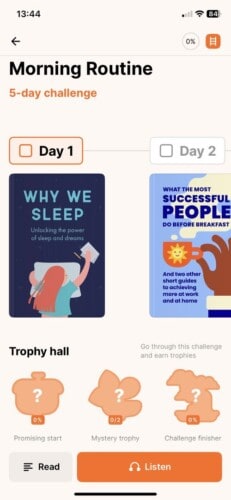
Then there are the challenges. These are time-based reading journeys—some lasting just 5 days, others up to 33—where you follow a set of themed daily book summaries. You can read at your own pace, and you earn trophies along the way (did I mention I love winning trophies?). One challenge I started was about morning routines, which was only 5 days. Another challenge I want to try is called The Empowered Woman. It’s a clever way to guide your learning without it feeling overwhelming.
There are lots of these, so I’m sure you’ll be able to find a Headway self growth challenge that suits you. Let me know which one you choose first.

On top of that, you’ve got:
- Bite-sized book summaries (15–20 minutes)
- Text and audio formats
- The option to highlight and save sections
- Flashcards with spaced repetition to help ideas stick
- A streak tracker that gives you a little push to come back each day
- Badges and gamified features that actually feel motivating rather than cheesy
What I Love Most
The streak tracker is one of my favourite things about the app. As someone who’s managed over 560 days on Duolingo, I know just how motivating it can be to keep a streak going—and Headway taps into that same feeling. Even though my current streak is zero (thanks to a weekend away), I still feel pulled to log back in and pick up where I left off.
The Headway book summary app is really easy to get around. It’s clean, clear, and doesn’t throw unnecessary stuff at you. I never felt like I was fighting the layout or searching for what I needed (apart from one thing – more on that in a sec).
The summaries themselves are short and to the point—enough to get you thinking or give you something useful to take away and try. Even on busy days, I’ve found I can squeeze one in and still feel like I’ve taken in something valuable.
One thing I really like is how the summaries are broken down even further into smaller chunks. It makes it easier to pause, reflect, or dip in and out without losing the thread.
If you’re reading (rather than listening), you can get through most summaries in under 15 minutes. And they’re a great way to figure out if a book is actually worth adding to your ‘to read’ list—or if the summary alone gives you what you need.
And the daily learning habit? Headway makes it feel achievable, not like a chore. That in itself is a win.
The Drawbacks
Like any tool, Headway isn’t perfect. If you want deep dives and nuanced arguments, you might find some of the summaries a bit light. Personally, I’ve found them helpful as a starting point—but I get why others might want more.
The challenges are another area that could be improved. Once you start one, it’s not saved to your profile in an obvious way, so you have to hunt for it each time. It’s a small UX issue, but one that adds a bit of time if the challenges are your thing.
Also, while the audio option is a nice feature, I sometimes find the voices a bit robotic. It’s not a deal-breaker for me as I have my own slightly robotic voice that I use in my own content. However, it’s noticeable and some people might not like it.
Lastly, the amount of choice can feel overwhelming at first. The collections and categories help, but a stronger filter or “Start Here” feature might make the onboarding feel smoother. Then again, you might stumble across something you weren’t looking for that turns out to be exactly what you need.
Headway App Price
Headway isn’t the cheapest app out there, but the price feels fair to me based on what it offers. Well, it is fair if you know you will use it. You’re not just paying for access to content, you’re getting a system that helps you learn more intentionally. At the time of writing, there are three main subscription tiers:
- $12.99 per month
- $29.99 every 3 months
- $89.99 per year
These prices will vary based on location and personalised offers. There’s also a 7-day free trial for new users, which is a great way to test whether the app fits your style.
Compared to other book-related subscription options like Blinkist, Shortform, or Instaread, Headway feels more purpose-driven. You get something that encourages you to reflect, take action, and actually remember what you’ve read.
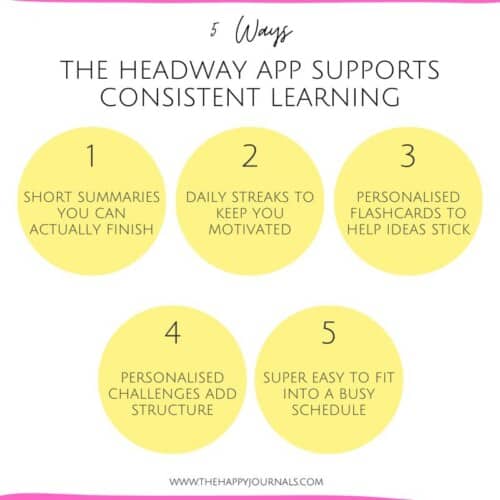
The streaks, challenges, and flashcards help build momentum, and there’s a real sense of progress over time. That shift from passive reading to intentional learning is what makes the price feel not only fair but valuable. If you use it.
Is the Headway app worth it?
If you’re anything like me, you enjoy learning, but you don’t always have the time or focus to dig into a full-length book. On top of that, I love using books to support my journaling practice, which means my reading list is always too long. So, I’m always on the lookout for ways to explore ideas, without feeling like I have to commit to an entire book every time.
The Headway app helps to take the pressure off. The summaries are short, which means I can actually get through them, and they often give me just enough of a spark to want to pause, think, or jot something down. I’m not just skimming ideas—I’m using them.
The streaks and challenges help with motivation, and the flashcards mean the ideas don’t disappear the second I close the app. It’s not just reading—it’s reflecting, without it feeling like hard work.
Of course, it’s not perfect. Some summaries feel a little light, and the audio narration isn’t always great. But if you treat Headway as a tool to support your reflection, rather than a complete replacement for reading full books, it really works.
Would I recommend it to other journalers? Yes. Especially if you’re looking for a way to bring more clarity, insight, or direction into your journaling, without adding another thing to your already-long reading list.

How I Use Headway with My Journaling Practice
One of the reasons I was excited to try the Headway app was to see how it could fit into my journaling routine. I’ve always seen journaling as more than just writing about your day—it’s a way to reflect, process ideas, and make sense of what’s going on in your head.
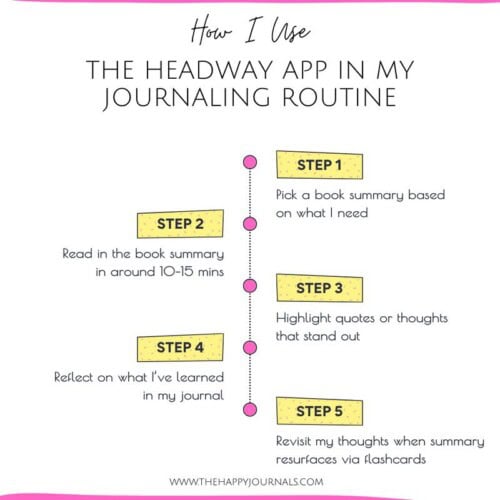
Using Headway as part of this process has been surprisingly helpful. The summaries give me just enough information to think about without overwhelming me. Often, I’ll pause halfway through a summary to jot down a quote or reaction. Other times, I’ll finish one and immediately open my journal to explore how the ideas connect with something I’m working through.
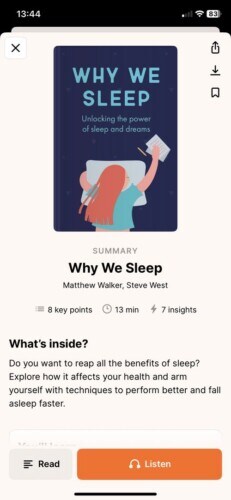
A good example of this was the summary of Why We Sleep by Matthew Walker. It instantly reminded me of how little thought I’d been giving to my own sleep habits—and within minutes, I was journaling about changes I wanted to make.
This idea of turning learning into journaling led me to find the Headway Self-Awareness Guided Journal—yes, they actually have one. It’s designed to guide you through 28 days of personal growth with questions and reflection points based on the app’s content. I haven’t used it yet, but it’s on my list. Hopefully, I’ll be able to do a Headway journal review soon.
At the heart of it, what I’m doing with Headway is keeping a learning journal. It’s a space where I capture key ideas, reflections, and patterns from what I read or listen to. It helps me make those insights stick—and more importantly, it helps me apply them to my life.
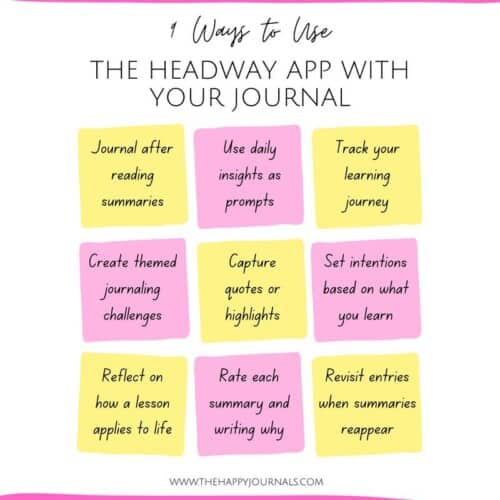
9 Ways the Headway App Could Be Used With Your Journal
There’s no one way to bring journaling and the Headway app together—it really depends on how you like to reflect and learn. But if you’re looking for ideas, here are some ways to combine the two:
- Journaling after summaries – Let each book’s key points spark personal reflection. You might write a quick response, explore how the idea is important in your life, or note how it made you feel.
- Using daily insights as prompts – A one-sentence takeaway can be more powerful than it looks. Treat it like a journaling prompt: write what you agree with, disagree with, or want to try.
- Tracking your learning journey – Keep a running log of what you’re learning, how your thinking evolves, or what themes keep popping up. This builds a clearer picture over time.
- Creating themed journaling challenges – Use one of Headway’s structured challenges as a journaling arc. For example, if you’re doing the Morning Routine Challenge, reflect daily on how the ideas relate to your habits.
- Capturing quotes or highlights – Don’t just save them—interact with them. Write about why the quote stood out, what it reminds you of, or how it connects with something else you’ve learned.
- Reflecting on how a lesson applies to your life – These book summaries work best when they’re explored, not just read. Take a moment to ask, “What’s one area in my life where this applies?”
- Setting a small intention based on each summary – Journaling can be a launchpad for change. Write down one small thing you’ll do based on what you learned.
- Rating each summary and writing why – Give the summary a score (out of 5, for example), then write what resonated—or didn’t. It’s a great way to sharpen your preferences.
- Revisiting past entries when summaries reappear via spaced repetition – This is one of those features that does its job in the background, but it’s actually really useful. When a concept comes back around through spaced repetition, I’ll often glance at what I wrote the first time and realise how much my thoughts have shifted—or what stuck with me without me even realising.
Intrigued? Try adding the Headway app to your journaling routine and see how you get on.
Wrapping Up
Headway is one of those apps that’s useful in more ways than you expect. It’s not trying to replace books, and it’s not promising big transformations—it just gives you solid, digestible ideas to work with, without the pressure.
The summaries are short, well-structured, and surprisingly helpful. Even if you only have ten minutes, it’s enough to pick up something interesting—and maybe even write about it. Whether you’re using the app to reflect, explore a theme you’re working through, or just to get out of a journaling slump, it’s full of easy wins.
What I’ve liked most is how easy it’s been to build it into my journaling process. I don’t have to search for a prompt or overthink where to start. I just open the app, read a summary, and there’s usually something that sparks a thought worth writing down. It’s helped me make use of short windows of time and stay connected to my journaling habit without it feeling like work.
And at the time of writing, there’s a one-time lifetime deal available on AppSumo for $59. If you know you’ll use the app regularly—or want to treat it like part of your personal development toolkit—that’s excellent value.
If you already use the app, let me know your best books on Headway in the comments, and I’ll add them to my list.
Disclosure: If you purchase anything from links in this post or any other, I may receive some kind of affiliate commission. However, I only ever mention products I love and would recommend regardless of commission.
Disclosure: I’m not a mental-health or medical expert, I just share what I’ve learned through my own research and experience. The ideas and prompts here are meant to help you reflect and grow, but they’re not a replacement for professional advice. You can read my full disclaimers here.