
Ever wondered what better clarity could do for your day? Or maybe you heard the term “Morning Journaling” but aren’t sure what it is. Don’t worry; I will help you figure it out in today’s blog post.

Disclosure: If you purchase anything from links in this post or any other, I may receive some kind of affiliate commission. However, I only ever mention products I love and would recommend regardless of commission.
Disclosure: I’m not a mental-health or medical expert, I just share what I’ve learned through my own research and experience. The ideas and prompts here are meant to help you reflect and grow, but they’re not a replacement for professional advice. You can read my full disclaimers here.
Grab a cuppa, and let’s get started!
What Is Morning Journaling?
Morning pages, or journaling, is a technique for starting your day more clearly and intentionally. Most people’s morning journals are based on a variation of Julia Cameron’s The Artist’s Way Morning Pages Journal, a guided companion to her renowned book, “The Artist’s Way.” The idea is that you write three pages each morning, expressing thoughts and feelings freely without judgment. By the end of the session, you should feel clear from any mental clutter, be able to identify potential creative blocks and understand yourself a bit more clearly.
Of course, there is no single “right” way to structure a morning page journal, but having a framework can make it easier to stay consistent. Here are four ways to try morning page journaling. (Please read to the end of the post so I can help you figure out how to get started.)
1. The Morning Pages Method (Julia Cameron’s Technique)
Morning Pages involve writing three full pages of stream-of-consciousness thoughts. There’s no structure—you just write whatever comes to mind, even if it seems trivial. There is no intention setting specifically, but you can do this as an extra task.
2. The Classic Three-Part Morning Journal
A simple yet effective format includes three key sections:
- Gratitude – Write 3 things you’re grateful for.
- Daily intentions – Set an intention or focus for the day.
- Reflection – Jot down any thoughts, feelings, or goals.
Example:
- Gratitude: I’m grateful for the morning’s sunshine, hot coffee, and a good night’s sleep.
- Intention: To stay present and focused on my work.
- Reflection: I feel energised today. Finishing my project is my main priority, and I will take breaks to stay refreshed.

3. The 5-Minute Journal Structure (Quick & Effective)
For those who want a structured yet time-efficient approach, the 5-Minute Journal format is ideal. It involves:
Morning Section:
- Three things you’re grateful for
- What would make today great?
- Daily affirmation (e.g., “I am confident and capable.”)
Evening Section: (Optional for later in the day)
- Three amazing things that happened today
- How could I have made today even better?
This format is perfect if you want to build a positive mindset but have limited morning time.
I have a complete guide here.
4. The Goal-Focused Journal (For Productivity & Planning)
If you’re using journaling as a tool to stay productive, try this structure:
- Top three priorities for the day
- Biggest challenge to overcome today
- One step toward a long-term goal
- Affirmation or mantra
Example Entry:
- Priorities: Finish presentation, respond to emails, schedule workout.
- Challenge: Staying focused despite distractions.
- Long-term goal: Write 500 words for my book today.
- Mantra: “Progress, not perfection.”
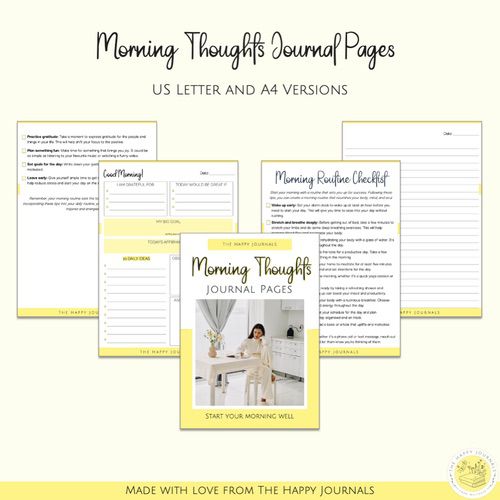
Grab the Morning Thoughts Journal Pages
Kick-start your day with this mini set of printable pages. Inside you’ll find a simple morning routine checklist, a daily journal page to clear your head, and a guided checklist to help you come up with 10 fresh ideas each morning.
Perfect for quiet mornings, busy minds, or anyone looking to ease into the day with intention.
Which Morning Journal Structure Is Right for You?
The best structure depends on your goals:
- If you want mental clarity, try Morning Pages.
- If you prefer quick journaling, use the 5-Minute Journal.
- If you wish to achieve goal-setting and productivity, go with the Goal-Focused Journal.
- If you like balance and positivity, use the Classic Three-Part Journal.

What Are The Benefits Of Morning Journaling?
Dedicating a few minutes each morning to journaling can set a positive tone for the day ahead. Benefits can include:
- Reduced stress and anxiety: Instead of carrying worries and to-do lists in your head, you can release them onto paper. Studies show that expressive writing, like journaling, can reduce stress, making it easier to start the day with a calm and focused mind (Baikie KA, Wilhelm K., 2005). Expressive writing has also been shown to lower cortisol levels, which reduces anxiety (Niles AN et al., 2014).
- An increase in focus and productivity: Writing daily can help reduce decision fatigue because you spot patterns and signs of what is and isn’t serving you. It does this by stimulating your prefrontal cortex, just as in creative writing (Carolin Shah et al., 2011.).
- Enhance creativity and problem-solving: Morning journaling also acts as a mental warm-up, helping you feel more creative. Research shows that the brain’s default mode network (DMN) is activated when we are engaged in spontaneous thought or daydreaming, leading to more innovative thinking and problem-solving.
- Improve emotional clarity and self-awareness: As with problem-solving, journaling can help you recognise patterns in your feelings and develop greater self-awareness and mood regulation (Smyth JM et al. 2018.).
- Strengthening gratitude and positivity: Studies show that practising gratitude can improve mood, increase resilience, and even enhance overall life satisfaction. Neuroplasticity (the brain’s ability to reorganise itself) ensures that writing regularly can positively influence your cognitive functioning.
- A supportive goal-setting and habit formation: Journaling keeps you accountable by regularly tracking your progress and reflecting on your goals. The brain’s reward system powers habit formation; the more you engage in a consistent habit (like morning pages), the more your brain associates it with positive feelings of accomplishment. Over time, this builds self-discipline and strengthens the habit.

Is Journaling In The Morning Better Than Nightly Reflection?
This is a common question I get asked here at The Happy Journals, and the answer entirely depends on what you need from your journaling practice.
Here’s what I’d say.
Morning Journaling
- Helps clear mental clutter and set the tone for the day
- Enhances focus and productivity
- Ideal for goal-setting and intention-setting
Night Journaling
- Helps process the day’s events and emotions
- Encourages relaxation and reflection
- Great for stress relief and gratitude

So, Would Morning Journaling Work For You?
If you are looking for more daily motivation and structure, morning journaling can help you plan your day with clarity and intent. If you are not a morning person, you may be forcing a habit you won’t stick to. In this case, you may prefer evening reflection to help you process your day.
The most important thing is that you find benefits from your practice. In which case, I’d recommend asking yourself these questions after a few weeks of morning journaling:
- Do I feel more clear-headed and focused in the mornings?
- Has my stress or anxiety decreased?
- Am I more productive and intentional with my time?
- Do I enjoy the process, or does it feel like a task?
How To Get Started With Morning Journaling
Here’s how you can make morning journaling an effortless and rewarding part of your routine.
- Set a dedicated time and place: Choose a quiet moment in the morning and remove all distractions. Pair it with another habit, like drinking tea or stretching, to make it a natural part of your morning routine.
- Don’t overthink it: Your journal is a judgment-free space. You don’t need perfect grammar or deep reflections every day.
- Stay consistent: Building a journaling habit takes time. Start by focusing on completing one week, then a month. If you miss a day, don’t stress—just pick it up again the next morning.
- Choose the right format (Digital vs. Paper): The best format is really whichever works for you. A paper journal is excellent for those who enjoy the tactile writing experience. Digital journals are perfect for those who like a digitised system of reference. If you need more help, check out my paper vs. digital journal guide.
- Consider pre-formatted vs. blank journals: Pre-formatted journals (Guided Journals) provide prompts, structure, and inspiration. Great for beginners who need direction. Blank Journals are best for people who prefer flexibility and customisation.
- Pick your framework: Classic, the morning pages method or the 5-minute method.
Morning Journaling Prompts If You Need Them
Generally speaking, you wouldn’t use prompts to journal each morning. The idea is that you are free-writing. But what if you are a beginner and need a place to start? Well, let’s look at five simple morning writing prompts.
- What is on your mind this morning?
- How do you feel this morning?
- What’s on your to-do list right now, and how does that make you feel?
- Are you procrastinating about anything?
- What do you wish you had time for this week?
Remember, there are no right or wrong answers here, and if you want to start with “I don’t know”, that’s okay too. Explore that. Ask how it makes you feel and ask what you can do to change that uncertainty.
Turning Morning Pages Into Goals And Intentions
Typically speaking, much of what you write might not make sense to anyone else. Free writing doesn’t require perfect grammar or structured paragraphs, but to you, it holds a lot of thoughts and feelings. These can all be indicators of intentions you’d like to set or goals you’d like to create. Go ahead and work on that.
- Step 1: Review your writing – what are you saying you most need? Are there any patterns in the types of things you need (or need less of) each day?
- Step 2: Pick a statement (intention)—what encompasses a positive move toward what you want? For example, if you need more social connections, your intention might be to “reach out to a friend and nurture your relationship.”
- Step 3: Set specific goals—What can you do today to move forward on your intention? For example, Call Anna tonight and have a 20-minute conversation, arranging a get-together soon.
- Step 4: Set your tasks – Add goal tasks to your calendar with notifications.
Morning Journaling: The Wrap-Up
Creating a morning journaling routine can be incredibly helpful in developing a more positive and actionable mindset. It gives you clarity and frees you up to think more creatively. And when you see more growth and changes happening in your life as a result of a simple 5-10 minute habit, it becomes abundantly clear that journaling is worthwhile.
I hope that in writing this, I’ve helped you think about morning pages and what they might unlock for you. I also hope that I’ve been able to help you get started.
If you want to explore other types of journaling, you might like this post.
If you have any questions, drop them in the comments below.
Disclosure: If you purchase anything from links in this post or any other, I may receive some kind of affiliate commission. However, I only ever mention products I love and would recommend regardless of commission.
Disclosure: I’m not a mental-health or medical expert, I just share what I’ve learned through my own research and experience. The ideas and prompts here are meant to help you reflect and grow, but they’re not a replacement for professional advice. You can read my full disclaimers here.
Grab the Morning Thoughts Journal Pages
Kick-start your day with this mini set of printable pages. Inside you’ll find a simple morning routine checklist, a daily journal page to clear your head, and a guided checklist to help you come up with 10 fresh ideas each morning.
Perfect for quiet mornings, busy minds, or anyone looking to ease into the day with intention.