
We’ve all been there—staring at a blank page, pen in hand, wondering where to begin. Pressure builds. We want to create something meaningful. Something we’ll read back a week or a year from now and not feel silly about. Overcoming the blank page can be tough. But journaling isn’t about writing perfectly every time; it’s about creating a space for yourself to reflect, process, and grow. Don’t forget that.

Disclosure: If you purchase anything from links in this post or any other, I may receive some kind of affiliate commission. However, I only ever mention products I love and would recommend regardless of commission.
Disclosure: I’m not a mental-health or medical expert, I just share what I’ve learned through my own research and experience. The ideas and prompts here are meant to help you reflect and grow, but they’re not a replacement for professional advice. You can read my full disclaimers here.
If you need a gentle nudge to get started, read on. I’m going to give you my tips for overcoming the blank page and working out what to write in your journal.
What To Write: Start With Freewriting
One of the aspects of journaling that I love the most is its freedom. You decide what you want to write and how you want to write it. But that doesn’t help if you aren’t clear on your journaling goals. Freewriting can provide great insight into how you feel and what might work as a writing habit.
So, what is freewriting? Freewriting encourages you to let your thoughts and feelings hit the page as they come to you. Scattered, chaotic and often, even without grammar. They are uncensored, unfiltered and, therefore, a true reflection of where you find yourself. They can help you brainstorm or work through whatever is on your mind.
Take some time to journal this way every day for a while. Write at least two to three pages or for 5-10 straight minutes. Don’t pause to edit or critique. Morning always works best (we call this practice morning pages, which you can learn more about here: https://www.thehappyjournals.com/morning-pages-vs-evening-reflection/
At the end of each session, read your entry and reflect on how you feel or where you might need help or change. Use this to help you set intentions or goals for the day.
Once you have been writing this way for a while, you’ll be better placed to establish if you need to add to or adapt your journaling method.
What To Write: Using Prompts If Freewriting Feels Uncomfortable
If you don’t enjoy freewriting or you’d like a style with a little more structure, then I recommend prompt-based journaling. Prompts provide a simple entry point, guiding you to explore specific themes or emotions. For instance, you might begin with something broad like “What’s on my mind today?” or opt for something more specific, like “What steps did I take today towards my goal?”
You can use the same prompt every evening or change things throughout the week or month. The idea is that through entry structure, you’ll start to notice patterns or behaviours more quickly, helping you set intentions for the next day or week. To me, this type of journaling is always better written in the evening because it often has a more reflective nature.

Overcoming The Blank Page: Try Bullet Journaling
Bullet journaling is really for those who love a structured journal layout. However, it can be more visually creative as you swap long paragraphs or detailed narratives with charts, grids, symbols, lists, and short notes to capture key thoughts and moments.
The beauty of this approach is its flexibility and ease. What you choose to track this month can change each month until you customise the system that works for you. This makes overcoming the blank page easier as there’s little pressure to go into tremendous detail unless, of course, you want to do that.
Some standard bullet journal sections to try:
- Daily Logs: Track your to-do list, appointments, or daily highlights. You can add a space for reflection at the end of each day to jot down your thoughts or feelings.
- Mood Trackers: Create a chart or colour-coded system to track your daily mood. Over time, this can help you identify patterns in your emotions and mental state.
- Gratitude Lists: Write down one or two things you’re grateful for daily. Let this practice shift your focus to a positive outlook, even when life feels chaotic.
- Habit Trackers: Monitor habits you’re trying to form or break, such as drinking enough water, exercising, or staying up late.
I recommend this book to learn about bullet journaling: The Bullet Journal Method by Ryder Carrol
Other Things You Can Try
While freewriting, prompts and bullet journaling are pretty great at beating blank page syndrome, there are other techniques you can look at. Here’s a handy list of things I feel have some merit.
- List Journaling: A list can be a simple and effective way to start writing, replacing lengthy morning pages or evening reflections. They can also be pointed and direct, which keeps you focused on creating good intentions. For example, a simple “to-do list” today can help you manifest a dream tomorrow. A list of the “3 things I’m grateful for” can help you practice a more positive approach to your days.
- Mind Mapping: Visualising your thoughts can often feel easier than writing them. This is where a mind map helps enormously. You don’t need an art degree to create one; a simple flow chart, spider chart, or word cloud will suffice. The idea is that these help you develop ideas or spot relationships from non-linear thinking.
- Intention Setting: Sometimes it’s not what you should write about you are struggling over; it’s the intention you come to your journal with. Let me explain. For example, when I was training for the Paralympics, my journal became heavily focused on my intent to win a gold medal. My entries were filled with training commentary, daily or weekly goals, etc. It also became a tool for squashing my limiting beliefs. So, every day, I would reflect on what was and set fresh intentions for the next day. It helped me create a more positive mindset to overcome the pressures of my goal. Now that I have finished competing, my journaling intention has changed, and I’m more focused on what’s here and now for me. Being adaptable and setting the right intention for my journaling approach helps me find plenty to write about.
And If You Are Still Stuck On What To Write, Embrace Imperfection
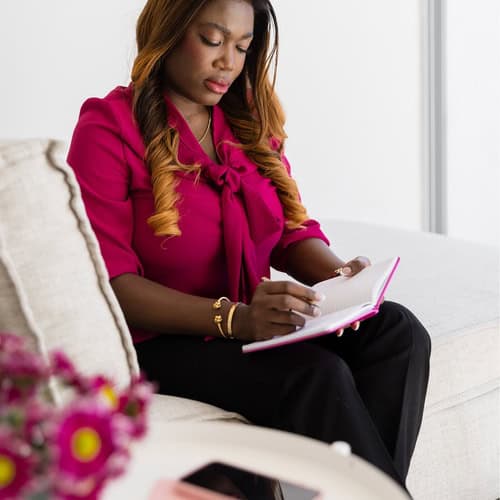
Often, the reason overcoming the blank page is so hard is that we’re aiming for perfection. But the truth is nothing you ever write about in your journal has to be perfect. You can cross things out, layer pages with stickers and doodles or leave things unfinished if you want to. Your journal is for you to read and find clarity in. It is your private, safe space.
And the only rule you have is that there are no rules.
So, give yourself permission to be imperfect.
Make a mark on page one. Be open to crossing through incorrect words or spellings. Be open to starting a new page. But most of all, write something.
I promise your next entry will align more with a journaling habit that serves you. Why? Because you’ll learn from today’s entry what works and what doesn’t.
Disclosure: If you purchase anything from links in this post or any other, I may receive some kind of affiliate commission. However, I only ever mention products I love and would recommend regardless of commission.
Disclosure: I’m not a mental-health or medical expert, I just share what I’ve learned through my own research and experience. The ideas and prompts here are meant to help you reflect and grow, but they’re not a replacement for professional advice. You can read my full disclaimers here.