
You may be used to negative thinking if you’ve had a continual run of bad luck or always see the downside in situations. Transforming negative thoughts is possible, and I have just the tool to help you.
Let me show you how I journal to reframe negative thoughts and develop a more positive outlook.

Disclosure: If you purchase anything from links in this post or any other, I may receive some kind of affiliate commission. However, I only ever mention products I love and would recommend regardless of commission.
Disclosure: I’m not a mental-health or medical expert, I just share what I’ve learned through my own research and experience. The ideas and prompts here are meant to help you reflect and grow, but they’re not a replacement for professional advice. You can read my full disclaimers here.
Transforming Negative Thoughts: The Ripple Effect Of A Negative Mindset
When you encounter challenges, feel uncertain, or face disappointment, a little negative thinking is natural and even protective in some situations. However, when it becomes a persistent part of your thought process, it can really affect your mental well-being.
You may begin to overthink and doubt your decisions and relationships, stalling opportunities. You might also become lonely or even angry.
It can also affect your physical health as you start to feel stressed and anxious (Thomsen, Dorthe Kirkegaard PhD, et al., 2004.). This can cause you to lose sleep, energy and focus.
So, Where Does Negative Thinking Start?
There are plenty of triggers in our everyday lives for negative thinking.
- Stressful events: Deadlines, conflicts, or unexpected life or work changes.
- Comparisons: Measuring yourself against others on social media or in real life.
- Unrealistic expectations: Setting overly high standards that are difficult to meet.
- Unresolved emotions and relationships: Suppressed feelings like anger or sadness can resurface as negative self-talk.
How do you recognise these triggers? I firmly believe that journaling will help you find them more easily.
Transforming Negative Thoughts: Why Journaling Is An Effective Tool For Change
Journaling has always been an excellent tool for organising thoughts, understanding emotions, and fostering a positive mindset. I’ve written a lot about the science behind it here.
When you write in your journal, you externalise your emotions, making them feel less powerful or intimidating. The distance this creates often gives you a bigger perspective on what’s happening. You take the power away from the negative emotion and really start to analyse what is and isn’t working for you.
Reflecting on your journal entries is another brilliant tool. You’ll be able to highlight recurring themes in your thought patterns, enabling you to challenge and reframe them.
And there are lots of different types of journaling that can help, such as
They can be separate journals or become a go-to all-in-one!

A Step-by-Step Guide To Transforming Negative Thoughts Through Journaling
I’ve been journaling for years, so I’ve had the time to find my groove. The way I journal and how I create a ritual around it have evolved. But if I were to start again today or offer advice to someone starting out, these would be my steps.
Step 1: Create your space
Finding the right environment to sit and journal will give you focus and help you develop a sustainable habit.
- Choose somewhere quiet and comfortable.
- Choose your tools: digital or physical notebooks, pens, stickers, highlighters, anything goes
- Set the mood: Do you need a coffee? Or would you like some background music? Find what helps you focus and settle to write.
Step 2: Write freely
Allow yourself to write about what’s bothering you without judgment or filtering.
- Pinpoint specific negative thoughts or beliefs. For example, “I’ll never be good enough” or “I always mess things up.”
- Reflect on what led to these thoughts. Was it a conversation, an event, or a memory?
- Write about how this makes you feel

Step 3: Challenge and Reframe
Once you’ve identified your negative thoughts, use your journal to analyse and reframe them.
- Ask yourself if this belief or thought is based on facts or assumptions. Is there evidence to disprove your negative stance?
- Finish your writing with positive reframing. For example, if your realisation was, “I always mess things up”, write a final line that says, “I’ve made mistakes before, but I’ve also succeeded and learned from them.”
This seemingly small step is actually a significant milestone. It is your “aha” moment. By reframing your thoughts, you remove the negative power and replace it with things you have done well and will continue to work on. That’s where growth becomes a positive action.
Step 4: Focus on Gratitude and Affirmations
As you finish, take a moment to reflect on how you were able to reframe and how that lightened your spirit and mood. Then, follow that up by starting a gratitude entry or writing an affirmation. This will reinforce the positivity you have found.
For gratitude you might write three things you’re thankful for.
As an affirmation, you might write, “I am resilient and can handle challenges.”
Step 5: Set Intentions
Now is the time to set some intentions for the next day, week or month. What would you like to create more of to keep that positivity a staple part of your thinking? You might want to learn more about something or do less of something else. Whatever it is, as long as it helps you lead to more positive outcomes, it can only be a good thing for your well-being.

Final Thoughts: Transforming Negative Thoughts Through Journaling
Journaling has been a powerful tool for transforming negative thoughts. It has bolstered my confidence during training and helped me monitor my well-being. That’s why I recommend it.
I’d love to hear how you get on. Leave a comment below and let me know how journaling works for you.
Disclosure: If you purchase anything from links in this post or any other, I may receive some kind of affiliate commission. However, I only ever mention products I love and would recommend regardless of commission.
Disclosure: I’m not a mental-health or medical expert, I just share what I’ve learned through my own research and experience. The ideas and prompts here are meant to help you reflect and grow, but they’re not a replacement for professional advice. You can read my full disclaimers here.
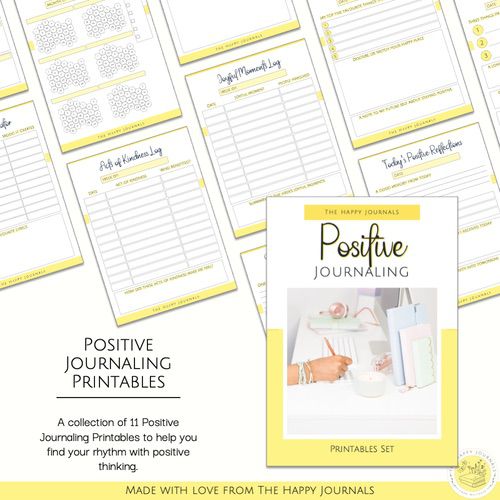
Grab the Positive Journaling Printables
This new collection of 11 Positive Journaling Printables has been designed to help you find your rhythm with positive thinking.
Here are a few of the printables you’ll get: Gratitude Highlights, Self-Appreciation Snapshot, Goals & Aspirations Sheet, The Happiness Map, Today’s Positive Reflections, Daily Affirmations Tracker