
Your emotions shape how you experience daily life, yet most of us move through them on autopilot. We tend to react without fully understanding what we’re feeling or why.
Disclosure: If you purchase anything from links in this post or any other, I may receive some kind of affiliate commission. However, I only ever mention products I love and would recommend regardless of commission.
Disclosure: I’m not a mental-health or medical expert, I just share what I’ve learned through my own research and experience. The ideas and prompts here are meant to help you reflect and grow, but they’re not a replacement for professional advice. You can read my full disclaimers here.
Mood and emotion journaling is a way to slow that down. By regularly recording your feelings and emotional reactions, you create space to notice patterns, identify triggers, and respond to situations with greater clarity and intention rather than just reacting.
In this guide, I’ll explain what mood and emotion journaling actually involves, why it helps, and how to start a practice that works for you – whether that’s quick daily mood tracking, deeper emotional processing, or a combination of both.
What is Mood & Emotion Journaling?
It’s the practice of regularly recording your feelings, moods, and emotional reactions to better understand yourself and your relationships. A proactive approach to processing and growing from what you learn.
By taking this approach, you are looking for patterns and identifying triggers. You are also looking at how you can change what might be causing you feelings that don’t serve you.
Now, for some of you, that might feel like deeper work than your standard daily or weekly journal. It might not fit into your normal notebook. In that case, you might decide to create a separate system to write in only when you need to.
But before we get to journaling systems, let’s talk more about the why.
Why Should You Journal for Better Mood & Emotional Well-being?
Okay, there’s no should when it comes to this type of journaling. You need to decide if this practice will be helpful to you in the long run. But if you wanted someone to give you a reason to journal about your moods and emotions, it’s this:
Our emotions play a massive role in how we experience daily life, yet we often move through them on autopilot. By putting pen to paper (or finger to screen), you create space to reflect, gain clarity, and even respond to situations with more calm and intention.
Mood and emotion journaling can give you immediate relief by releasing pent-up feelings, reducing stress and tension in the moment. And by naming your feelings, you give structure to what might otherwise feel chaotic or overwhelming.
There are also longer-term benefits. I’ve felt more resilient in situations. Able to bounce back quicker. I’ve also been able to institute change on my terms, both when and where I see fit. As a result, these days I feel more proactive than reactive.
How Does Mood & Emotion Journaling Work?
There are two key approaches
- Mood tracking
- Emotion processing
Mood Tracking: The “What”
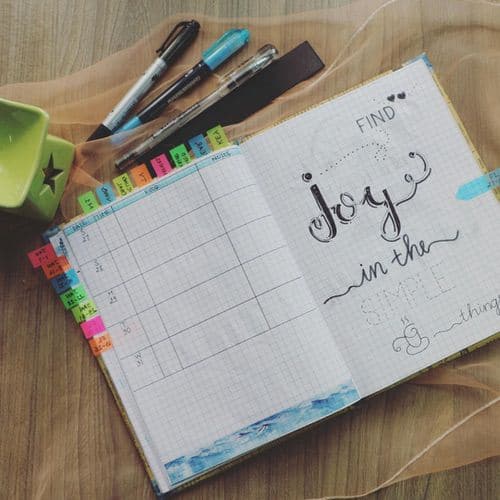
By tracking your mood, you are focusing on observing and recording your overall emotional state. You can use a bullet journal table for this; rows for the emotions you want to track, and the columns for the frequency you want to record.
Your table is a quick check-in that takes no more than a minute to complete and helps you spot patterns over time. For example, you might notice that your energy dips every Monday or that you feel happier on certain days.
Emotion Processing: The “Why”
Emotion processing takes your tracked mood information and goes deeper.
Here you’ll reflect on why you feel a certain way and explore the context behind your mood. This might involve writing about specific events, thoughts, or interactions and noticing how they influence your emotional health.
Why Both Matter
Tracking moods gives you data; processing emotions gives you understanding. If you journal about both aspects in tandem, you become more emotionally aware. You begin thinking proactively: “What can I do to help or change in this situation?”
How to Start Mood & Emotion Journaling for Yourself
How-tos are always tricky to pen, especially for journaling, because the practice that serves us best in the long run is something we come to for ourselves. And so what works for me might not for you.
For example, if you wanted to start bullet journaling today, the original system designed by Ryder Caroll might work for you. Or you might prefer an adapted system you’ve found on Instagram or Pinterest.
So, what should I suggest? Well, the best advice is to ‘always start simple’.
Simple Steps to Start Journaling
- Choose your tools: Pick either a paper journal, a digital app or a hybrid approach. Remember to include in that system tools and processes that’ll make you want to journal regularly.
- Decide on your time commitment: Do you need something that takes, say, 5-10 minutes to complete, or do you need something that gives you longer to process and explore deeper feelings? Or a mix of both?
- Mood tracking: Set up a simple process of tracking your moods or mood changes.
- Name your emotions: Give yourself a line to describe what emotion you are feeling (good, bad or ugly).
- Note any obvious triggers or context for your feelings: What happened, where, and with whom?
- Give yourself space to write more if you need to; stream-of-consciousness journaling can really help. It’s the practice of writing for up to three pages without pausing to think too deeply. Then you read this back to see what you can spot.
- Reframe or release that feeling: Use a line or two to do this. You can literally write, “I release this feeling of ‘x'” if that feels helpful.
- End on a positive note: Sometimes feelings are complicated. Sometimes you can’t resolve them quickly. To avoid feeling low when you close your journal, always end on a positive note. I like to set an intention or give myself some motivation.
Stuck on What to Write? Prompts Can Help
Those first few posts are sometimes the hardest to write. So to make life a whole lot easier for you, I’ve developed 23 mood and emotion journaling prompts.
You can pick one for mood awareness, one for emotional exploration and a third for reframing and/or release. Or you could write your own.
Can You Regulate Emotions Through Journaling?
Expressing your feelings can be cathartic, which, in itself, can calm the nervous system. But to get there, you have to really feel what you are feeling. For all of us, that means recognising, expressing and releasing it. In that order. There’s a great article about it in Psychology Today if you are interested.
Writing is a great way to give your emotions and moods the space they need to be recognised, expressed and released.
You can pair your journaling practice with other beneficial activities, such as breathwork or exercise, for added support.
Wrapping Up Mood and Emotion Journaling
Mood and emotion journaling isn’t about fixing yourself or always finding resolution. It’s more about creating the space you need to recognise what you’re feeling, express it, and release it when you’re ready.
Start simple: track your mood daily for a week, then add one or two prompts when you need to dig deeper. Give yourself grace as you figure out what works – some sessions will feel cathartic, others might leave you sitting with uncomfortable feelings. That’s all part of the process.
When You Need More Support
If journaling brings up emotions that feel overwhelming to handle alone, please reach out to your support network or a professional. Here are some UK resources:
For immediate and crisis support, contact
- Samaritans: Available 24/7 for anyone who is struggling to talk.
- Phone: 116 123 (free)
- Email: jo@samaritans.org (responses may take a few days)
- Shout: A 24/7 text service for urgent support.
- Text: “SHOUT” to 85258 for free, confidential support
- Text: “YM” to 85258 if you are under 19
- NHS 111: For urgent mental health support.
- Call: 111 and select option 2 for a 24/7 mental health helpline
- Online: Use the NHS 111 online service
- In an emergency: If you or someone else is in immediate danger, call 999.
For information and ongoing support
- Mind: Offers resources on a wide range of mental health topics, legal advice, and helplines.
- The Mental Health Foundation: Provides information and support for a variety of mental health concerns.
- SANE: Provides support for people with mental health conditions.
Disclosure: If you purchase anything from links in this post or any other, I may receive some kind of affiliate commission. However, I only ever mention products I love and would recommend regardless of commission.
Disclosure: I’m not a mental-health or medical expert, I just share what I’ve learned through my own research and experience. The ideas and prompts here are meant to help you reflect and grow, but they’re not a replacement for professional advice. You can read my full disclaimers here.