
You pull everything out of the wardrobe, make three neat piles (keep, donate, bin), and then spend twenty minutes holding one jumper. The piles stay empty, the bedroom floor is now worse than when you started, and you close the door and tell yourself you’ll try again at the weekend.

Disclosure: If you purchase anything from links in this post or any other, I may receive some kind of affiliate commission. However, I only ever mention products I love and would recommend regardless of commission.
Disclosure: I’m not a mental-health or medical expert, I just share what I’ve learned through my own research and experience. The ideas and prompts here are meant to help you reflect and grow, but they’re not a replacement for professional advice. You can read my full disclaimers here.
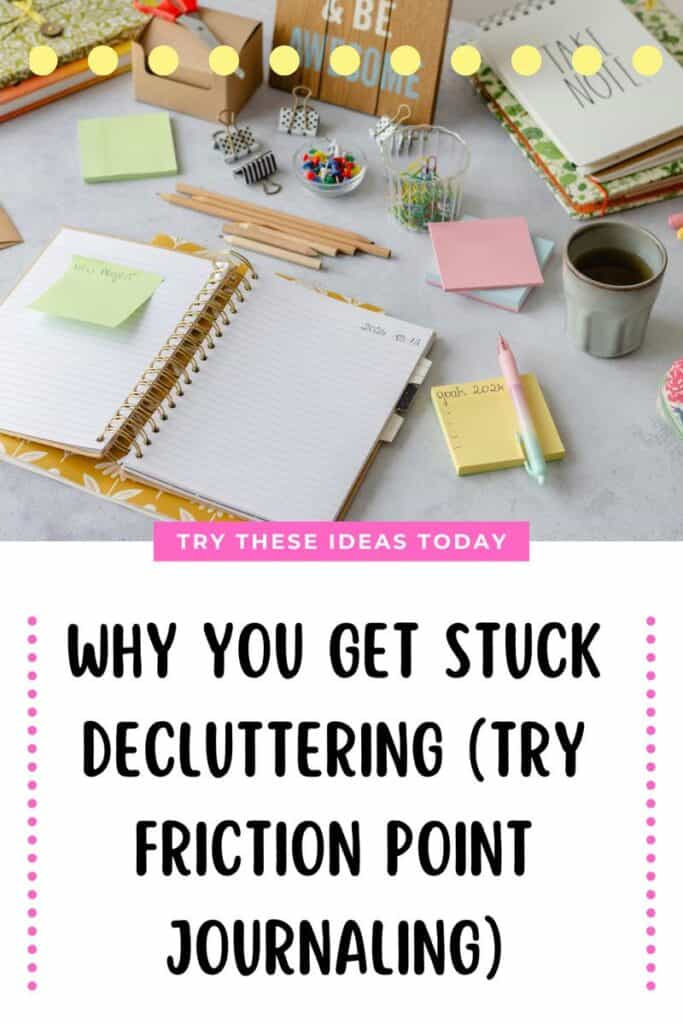
Getting stuck like this isn’t a lack of willpower. Each item needs you to make a decision, and some come with guilt, memories, or fear of needing it next year. Friction point journaling gives you a way through: write down what’s stopping you, name how it feels, and choose one small step so you can keep sorting.
This post is for anyone whose decluttering keeps stalling halfway. You’ll find out why it happens, how to write a friction point entry, which journaling method suits ADHD, anxiety, grief or low energy, and what to do when the job is as big as moving house.
What Causes Us ‘Overwhelm’ When We Declutter?
Here is the truth standard organising advice often forgets to mention: Decluttering is rarely a space problem; it’s more a decision-making problem. One that can easily trigger what scientists call ‘cognitive overload’. And that’s why giving ourselves a physical task, like “just throw away anything that doesn’t spark joy” or “set a timer for 30 minutes and blitz the room”, doesn’t always work, because it doesn’t address the emotional weight, sensory fatigue, and memories we’ve bestowed in our favourite t-shirts, half-finished notebooks or comfy old shoes.
This is especially true if you are decluttering during or after a period of grief. Don’t forget to take care here. If the decluttering brings up strong emotions, which it understandably will, take a break, or reach out to someone you trust for support.
What is Friction Point Journaling? And How Can It Help?
Writing through your overwhelm shifts your focus from what to throw away to what’s stopping you from letting go. So, instead of giving up, you identify the exact emotional or cognitive barrier, write it down, and remove the friction.
It helps you externalise your mental state before and during decluttering, soothing your nervous system and helping you make intentional progress.
The Science Bit: Journaling as a Cognitive & Emotional Buffer
Whether you like to bullet-point journal or write long entries, journaling has been shown to act like an extra workspace for your brain.
- It Regulates Emotional Noise: When you feel overwhelmed, your amygdala (the brain’s threat centre) becomes activated. Writing about your stress externalises that internal noise and lets you reason with it so that you can think more clearly.
- It Serves as External Working Memory: For those dealing with ADHD or decision fatigue, working memory is sometimes a scarce resource. As you write in your journal, your decluttering plan helps you pick back up the loose threads you let go of when your attention strays.
- It Uncouples Identity from Objects: We often hold onto items because they feel tied to who we were, who we wish we were, or someone we loved. Journaling creates psychological distance, helping you separate who you are from what you own.
- It Can Hold Space for What You Let Go Of: It’s perfectly normal to want to capture an object’s memory. A journal can help you document things just as it can help you remove friction.
There is a lot of really interesting scientific data around this topic. You can apply it to many situations where you feel overwhelmed. In this case, decluttering.
The Core of Your Friction Point Journal Entry
Every entry should help you:
- Spot the friction: The zones or object(s) that are causing you to pause your decluttering efforts.
- Name the emotion: Identify what you are feeling. Is it guilt, fear of waste, nostalgia, or simple physical fatigue? Are you struggling with sensory overload, or is it purely emotional or cognitive?
- Write the fix: What micro-step(s) can you take to overcome this specific barrier? For example, if sorting a closet feels too big, write down, “I will only sort long-sleeved shirts today.”
- Anchor the Win: Log what you removed or reorganised to create tangible evidence of progress that makes the project feel that little bit smaller.
What that looks like as a journal entry is entirely up to you. But if I were to give one piece of advice, it’d be this: Tailor your journal template to how you operate or how you are feeling.
Tailoring the Right Friction Point Journaling Method to Your Mental & Emotional State
It would be unfair to imagine there’s a one-size-fits-all approach to friction point journaling, particularly in this case. Just like any other type of journaling, it can only serve you if it’s designed to work with what you are going through. For example:
1. ADHD & Executive Dysfunction (The Journal as External RAM)
- What Often Happens: Getting distracted by items, losing track of steps, or fearing that putting something away means you’ll forget it exists.
- The Journal Technique to Try: Use an Anchor Page. Write down the exact, hyper-specific action you are taking right now (“Sorting blue shirts into the keep pile”). Keep the open notebook right next to you. If you get distracted by an old photo or a missing sock, look at the page; it will immediately pull you back to task. You can also create and number steps ahead of time if that helps you.
2. Anxiety & Overwhelm (The Journal as Risk Regulator)
- What Often Happens: Catastrophising and fear-based keeping.
- The Journal Technique to Try: Write a Reality Check Log. List the item you are considering giving away, throwing out, or donating, then write the absolute worst-case scenario if you part with it, and a realistic safety net. For example: “Item: Extra power cable. Worst case: I need it next year. Reality check: I haven’t used it in 3 years, and a replacement costs £6 online. It is safe to let go.”

3. Grief & Heavy Nostalgia (The Journal as a Memory Container)
- What Often Happens: Guilt over parting with heirlooms, gifts, or items belonging to a loved one, feeling as though discarding the physical object erases the love or memory attached to it.
- The Journal Technique to Try: Use a Memory Transfer Prompt. Write a brief 2-3 sentence tribute to the item. Describe where it came from, why it mattered, or what memory it held. Take a picture you can print out later if you need to. Transferring the emotional story onto your journal page gives you permission to let go of the physical object.
4. Depression & Low Energy (The Journal for Micro-Momentum)
- What Often Happens: Heavy physical fatigue, apathy, or negative self-talk regarding the state of your space.
- The Journal Technique to Try: Write a micro-log detailing each of your small wins. For example: “10:00 AM — Moved 2 empty water bottles to the sink. 10:02 AM — Placed junk mail in the recycle bin.” In no time, you’ll start to see the progress you’ve made, which in turn spurs you on.
If You Have a Much Bigger Decluttering Task, Like Moving House
When you need to declutter a much larger space, it’s really important to plan ahead. I recommend starting with this post: How to Journal Your Way Through a Room-by-Room Reset
Then break down your efforts to focus on:
- Narrowing the scope of each decluttering session to 10 minutes or 1 surface. Small wins can build momentum without draining your battery (emotional or physical), giving you plenty of time to friction journal as needed.
- Separate your decision-making from the physical action. By writing a list of what you plan to declutter before you start, you remove that feeling of uncertainty. It also gives you a clear focus of what your decluttering session should achieve.
- Use a “Holding Zone” box. If you really can’t decide whether to get rid of something and you need a little more journaling time or space, put it in an opaque box labelled with a date 30 days out. Store it where you can’t see it. If you don’t look for it within that month, it is safe to donate it or give it away to someone who will enjoy it, giving that memory a new lease of life for someone else.
Need Some More Help With What to Write?
If none of my earlier page ideas quite fit the bill, try a prompt. They’re simple to use and can often cover multiple decluttering situations.
Here are 5 journal prompts for decluttering paralysis:
- When I look at this pile, the physical sensation I feel in my body is…
- I am hesitant to let go of [Item] because I am afraid that…
- If I get rid of this, what story am I letting go of about my past or future self?
- What is the absolute smallest action I can take right now that requires zero emotional energy?
- If a dear friend were holding onto this object, what advice would I give them?
Remember, Decluttering is a Form of Self-Care, So Take Care!
Decluttering your space is an ongoing act of self-care that helps you enjoy your surroundings again. When the task feels too big, reach for a tool designed to help you. A Friction Point Journal. It can be a separate notebook or part of your everyday journal or pocket notebook. I highly recommend the HOMEMARS A6 Pocket Notebooks (bulk pack) if you want to create mini journals for different things, like friction point journaling.
Let your journal do the heavy lifting where you need it to, so you can get on with decluttering as and when you need to.
Further Reading
If this blog has been helpful for you, I can recommend a few more on similar subjects that will be worth a read:
- How to Set Up Your Bullet Journal to Track Your Cleaning Habits
- Write Your Dream Home: 10 Journal Prompts to Align Your Home with Your Life
Try Friction Point Journaling Before Your Next Declutter
Decluttering often stalls when a decision gets stuck, and the clutter itself is rarely the cause. Friction point journaling helps because it takes the decision out of your head and onto the page, where you can see it, question it and shrink it into something you can do in ten minutes. Once you know what’s holding you up (guilt over a gift, say, or a worry that you’ll regret binning it), the pile in front of you stops feeling like a verdict on you.
Pick the one thing you keep avoiding, whether that’s a drawer, a shelf or a single bag, and write three lines before you touch it: what’s in the way, what you’re feeling about it, and the smallest step you can take. Then do only that step.
Which method are you going to try first: the Anchor Page, the Reality Check Log, the Memory Transfer Prompt or the Micro-Log? Tell me in the comments, and if you know someone who’s been staring at the same cupboard for months, send her this post.
Disclosure: If you purchase anything from links in this post or any other, I may receive some kind of affiliate commission. However, I only ever mention products I love and would recommend regardless of commission.
Disclosure: I’m not a mental-health or medical expert, I just share what I’ve learned through my own research and experience. The ideas and prompts here are meant to help you reflect and grow, but they’re not a replacement for professional advice. You can read my full disclaimers here.