
Budget binders look brilliant online: rows of colour-coded cash envelopes, labelled tabs, a satisfying zip. Then you buy one, fill the first few pockets, and find you’ve got a second system to carry around and remember to open, on top of the journal you already use every day.

Disclosure: If you purchase anything from links in this post or any other, I may receive some kind of affiliate commission. However, I only ever mention products I love and would recommend regardless of commission.
Disclosure: I’m not a mental-health or medical expert, I just share what I’ve learned through my own research and experience. The ideas and prompts here are meant to help you reflect and grow, but they’re not a replacement for professional advice. You can read my full disclaimers here.
Your journal can do the same job, and it does something a binder can’t: it holds the reasons behind your spending next to the numbers. A few card envelopes, a dashboard spread, and a bit of washi tape give you the same “I can see my savings growing” feeling, in one notebook you actually keep with you.
This post shares budget binder setup ideas for your journal, whether you want real cash envelopes in your journal’s back pocket or monthly spreads, or a digital version that keeps your money safely in the bank. It’s for anyone who loves the idea of cash stuffing but would rather not add another thing to their bag.

Why I Think That Your Journal Beats a Budget Binder (Spoiler: It’s the Psychological Edge)
Budget binders are an excellent gateway to financial awareness, but they have a major blind spot: they track what you spend and what you save, but they ignore the why. By merging your financial journaling with your self-care journaling practice, you can create a space for emotional reflection alongside your numbers. This adds clarity that helps you make real changes in how you approach your money.
For example, let’s say you spent extra today on buying pizza for dinner. An overspend on your typical daily food budget. In a budget binder, you’d simply track the spend and flag that you overspent. By using your journal instead, you can understand why you spent what you spent. You might realise it was because you were burnt out after work and didn’t have anything in the fridge, or you received really good news and wanted to celebrate with a treat.
Understanding what triggered the spend is as important as acknowledging that you overspent, because it helps you make adjustments instead of beating yourself up. In this case, that might mean meal planning for nights like this or setting aside part of your future weekly budget for treats when that feels right.
To me, this has a much better emotional and mental outcome.
I talk about money more in another blog post: From Anxiety to Abundance: How Money Journaling Changes Your Mindset. I recommend reading that, particularly if the subject of money makes you feel a little anxious.
But what about all the plastic envelopes for savings? Do you need those, or can you do that in your journal too? Absolutely, you can. Let’s look at that next.
Setting Up Your Journal: Including Budget Binder and Savings Envelopes in a Journal
The biggest drawback of pre-made budget binders or money organisers is that they force you into someone else’s system. Using a journal gives you ultimate control over how you adapt the concept to fit your lifestyle (and how that changes over time).
I have a full bullet journal setup here: How to Set Up Your Bujo for Finance Journaling, which I recommend reading. That will help you create 3 things:
- Your dashboard and goals
- Your monthly, weekly and daily spreads
- And your review space
If you haven’t used a finance journal before or worked with specific spreads, this is a great starting point to experiment with. But one you don’t have to stick to rigidly if you don’t want to.
What I want to add in this post is a little about the idea of including cash envelopes.
First, I don’t agree that having lots of cash in the house or on your person is the most secure idea. In fact, I generally only have an “emergency” £20 note in my house (”emergency” also covers the quarterly Chinese takeaway). So, if you are going to use this system, make sure that you pop to the bank regularly to drop these ‘savings pots’ into actual savings accounts where you can earn interest. I’ll talk about a digital option as we go through this, if you’d rather keep your cash in your bank rather than in your journal or pocket notebook.
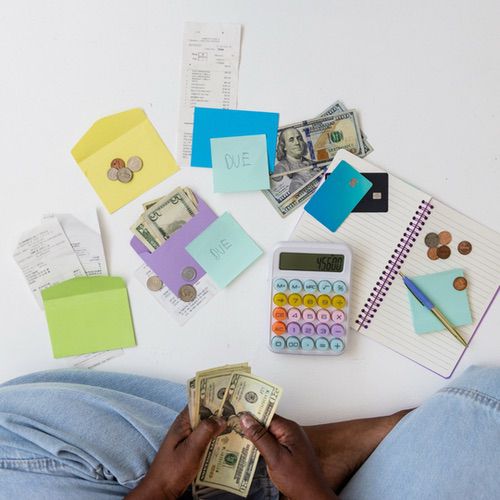
The idea behind cash envelopes is to budget or save an assigned amount in notes each week/month, and by physically seeing how well you do over time, you get more excited to keep going. And for many, this works really well.
Somewhere in your bujo or journal, add your envelopes. Keeping to just two or three with aligned goals makes it easier to start.

Setup 1: Cash Envelopes in Your Dashboard
Your dashboard is a static set-up, something you’ll return to again and again throughout the year. And because it’s static, it’s an obvious place to store your envelopes. One place to return to and use again and again.
Depending on the size of your journal, you might prefer these on the double spread preceding the key elements of your dashboard, but either way, use card envelopes that are easy to secure and stand the test of time.
String and washer envelopes are worth considering. They won’t open easily if you carry your journal places, and they have a reasonably low profile, so depending on your journal paper weight, you shouldn’t have too much issue writing on the next page (considering paper weight? I’d go for something around 90-160gsm). You can also decorate them or create your own template, using paper or card of your choice.
Once these are empty, you can repurpose the envelopes as message or photo holders that showcase what you achieved with each goal.
Setup 2: Cash Envelopes in Your Monthly Spreads
This setup means a few more envelopes, because you’ll need twelve months’ worth (depending on how long your savings goals last), and I’d pop these with your trackers, so that when you repurpose the envelopes at the end of the month, you can use them to show how much you saved. Maybe that’s a mini goal tracker or a deposit receipt?
The Digital Option
The idea of saving physically is to see the difference it makes and explore how that connects emotionally. But if you really don’t like the idea of saving cash outside the bank, you can include mini envelopes in your journal to track your digital efforts.
To start, you’ll need three things:
- Set up digital savings pots, or separate savings accounts with your bank, so you can see them in your digital app. If you’re in Europe, I highly recommend Plum because you can set it up to move the money for you (sign up to Plum here). If not, Wise is great because it allows you to set up “Money Jars” that earn daily interest in your choice of currency (sign up to Wise here).
- Set up standing orders to move cash from your main account to each savings account, or reminders to do it manually.
- An idea of how you want to present that physically. Maybe you design little savings cards for each envelope, colour-code them for different goals, or decorate them with doodles or stickers that match your monthly theme. For example, you could use a different shade of green for each savings category, or create a mini tracker shaped like a coffee cup for your ‘café fund’. You might even use themed washi tape or print out small photos to represent what you are saving for.
Once you have these in place, you can save at the end of each week or month as you plan, but take the extra step of recording your efforts for those mini envelopes in your journal.
You can do the same with budgeting for specific spending areas. For example, if you want to budget for going out, use an account where you transfer exactly what you have left to spend so you stay within your means.
Set Up Your Budget Binder in Your Journal
A binder tells you what you spent and what you saved. Your journal tells you that as well, plus why you spent it, and that’s what lets you change a habit instead of just noticing it. The envelopes bring the physical side: seeing a goal fill up, then repurposing the empty envelope as a keepsake of what you managed, is a reward a banking app can’t give you.
Start with one goal this week. Make a single envelope (or a mini tracker, if you’re going digital), label it with what you’re saving for and the amount, and put it in your dashboard spread. Add a second one once the first is running smoothly.
Which setup are you going to try: envelopes in the dashboard, envelopes in your monthly spreads, or the digital option? Tell me in the comments, and if you’ve found a clever way to make your own envelopes, I’d love to hear it.
Disclosure: If you purchase anything from links in this post or any other, I may receive some kind of affiliate commission. However, I only ever mention products I love and would recommend regardless of commission.
Disclosure: I’m not a mental-health or medical expert, I just share what I’ve learned through my own research and experience. The ideas and prompts here are meant to help you reflect and grow, but they’re not a replacement for professional advice. You can read my full disclaimers here.