
Some seasons hand you inspiration on a plate. Winter… takes a bit more coaxing. But that doesn’t mean there’s nothing to say — quite the opposite, actually. It’s a season of stillness, strange energy dips, and unexpected clarity. But it’s also full of contradiction, which makes for some great winter journal topics. There are moments of celebration and connection tangled up with long afternoons that feel like they’re moving in slow motion. That mix is exactly what makes winter such an interesting time to journal.

Disclosure: If you purchase anything from links in this post or any other, I may receive some kind of affiliate commission. However, I only ever mention products I love and would recommend regardless of commission.
Disclosure: I’m not a mental-health or medical expert, I just share what I’ve learned through my own research and experience. The ideas and prompts here are meant to help you reflect and grow, but they’re not a replacement for professional advice. You can read my full disclaimers here.
This post isn’t full of quick prompts or surface-level seasonal themes. These winter journal topics are a little different — bigger ideas you can return to again and again, depending on your mood, energy, or what’s been lingering in the back of your mind lately.
If you’re someone who enjoys reflective writing (or wants to get better at sitting with your own thoughts), this list might be just what you need. Just some layered, thoughtful topics that can stretch across a whole page… or a single sentence. Let’s see which one grabs you first.
Hibernation Is a Natural Part of the Cycle
Hibernation doesn’t have to mean shutting down entirely. It can simply be a change in pace, in energy, in how much you’re doing (and how much you want to be doing). Journaling about your version of hibernation can help you notice where you crave quiet, what kind of rest actually helps, and whether the pressure to “keep going” is coming from within or elsewhere.
This is a great time to reflect on your relationship with productivity, comfort, and how your energy fluctuates throughout the season. You might write about what your body wants more of right now. Or about the kind of spaces (physical or emotional) that help you slow down without checking out entirely.
Related reading: Your 7-Day Winter Journal Challenge
What Stillness Teaches You (That Busy Never Could)
Stillness isn’t always peaceful. Sometimes it feels awkward, itchy, or like you’re forgetting something important. But that’s the point. Sitting still gives you the chance to notice what you usually rush past.
This is one of those winter journal topics that can take you in surprising directions. You might write about how you respond to quiet — do you fill it, resist it, ignore it? Or you could explore what stillness has revealed to you recently. Not a grand epiphany, necessarily. Just the little shifts you’ve felt when things slowed down.
Related reading: 21 Winter Journal Prompts That Go Deeper Than the Weather

Embracing Boredom (And What Comes Out of It)
Winter is full of lulls — gaps in plans, quiet afternoons, evenings that seem to stretch forever. Instead of filling every moment, what if you wrote (or created) through the boredom? Not to escape it, but to see what’s underneath.
Journaling about boredom isn’t about creating something exciting; it’s about acknowledging and understanding it. It’s about noticing what you instinctively do when nothing is demanding your attention. Do you scroll? Snack? Start a project you don’t finish?
This topic can also spark creativity. You could write a stream-of-consciousness page, sketch whatever comes to mind, or even create a collage that captures how boredom feels. It doesn’t have to look like anything. It just has to show up.
A basic dot grid journal or a pack of visual journaling supplies can be great tools here if you want a way to explore these kinds of winter journal topics freely, without needing a plan or a polished result.
Rebuilding Resilience After Burnout
Winter often highlights things we’ve been pushing through — exhaustion, overcommitment, or the signs of burnout that are easy to ignore when life’s moving quickly. In the pause between seasons, you might notice just how tired you really are.
This journal topic isn’t about fixing yourself. It’s more about getting honest: How are you really doing? What signs of burnout have crept in? And what would it mean to give yourself a slower recovery, one that doesn’t need to look productive?
You could write about energy patterns, emotional exhaustion, or the habits you fall back on when you’re stretched too thin. Even just acknowledging it on paper can feel like a relief.
Burnout: The Secret to Unlocking the Stress Cycle by Emily and Amelia Nagoski is a science-backed but relatable read if you’re looking for something that explains why you feel the way you do — and what helps.
Related reading: Winter Goals Journal: How to Set Intentional Goals for the Season Ahead
Letting Things Go (Without Needing a Big Reason)
Winter can be a natural backdrop for release — not in a dramatic way, but in the slow, subtle way things shift when you stop holding them so tightly. This topic isn’t about making big life changes. It’s about noticing what you’re ready to loosen your grip on.
You could journal about habits you’ve outgrown, thoughts that keep looping, or responsibilities that no longer feel like yours to carry. Or it could be something much smaller: a plan that no longer fits, a routine that no longer serves, a goal that quietly expired.
Letting go doesn’t always mean walking away. Sometimes it simply means permitting yourself to stop forcing it.
A guided journal focused on mindfulness or emotional release can be helpful here — look for one that gives structure without pushing you toward a specific outcome.
Playing With Cold-Weather Creativity
Winter tends to push us indoors — physically, and sometimes mentally too. But that smaller space doesn’t have to feel limiting. It can actually be the perfect container for creative ideas to unfold, especially when there’s no pressure to make something perfect.
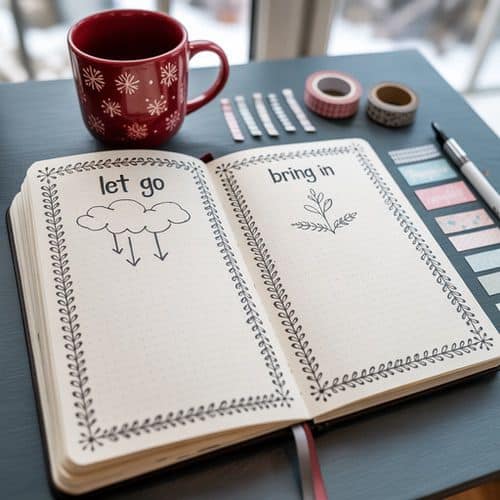
Winter journal topics like this could mean experimenting with texture, colour, or layout. Try building a page around a theme (like “comfort” or “static”) or using scraps of paper, magazine clippings, and random stationery to create something instinctive. This is where mess is welcome.
A set of washi tapes, glue rollers, and assorted ephemera can turn a blank page into a tactile playground.
Related reading: Winter Art Journaling Ideas That Mix Creativity with Self-Expression
What Winter Teaches You About Boundaries
There’s something about cold weather that sharpens your sense of personal space. It could be the pull towards comfort, or the fact that everything outside your door requires a little more effort. Either way, winter can make it easier to see what you’re saying yes to out of habit, and where you need a clearer no.
This journal topic is all about noticing what drains you, what protects you, and where your limits are right now. You might explore boundaries in your relationships, in your time, or even with your own expectations. What needs more room? What needs a firmer line?
A journal that includes prompts on self-awareness and emotional intelligence can help guide these reflections in a focused way.
Your Energy, Your Rhythm
This is the season where energy can shift wildly, sometimes from hour to hour. One day you’re buzzing with ideas, the next you can barely be bothered to reply to a text.
This journal topic invites you to track those changes without judgment. You might reflect on what affects your energy the most — sleep, sunlight, social plans, work demands.
Or use your journal as a rhythm log: note down how you feel at different times of day, what activities give you energy, and what drains it.
A simple mood tracker, energy log, or printable habit chart could support this reflection if you enjoy visual cues.
Wrapping Up Winter Journal Topics
If you’ve made it this far, you’ve probably found a few winter journal topics that speak to you, or at least make you pause. These themes aren’t here to tell you what to write. They’re here to help you notice what’s already occupying space in your mind and heart.
Whether you explore one topic or all of them, journaling through winter can help you tune into what is going on for you and the world around you. If you’d like a bit more direction, structure, or creativity along the way, consider the 7-Day Winter Journal Challenge, which offers a light structure to follow for a week.
What topic are you starting with?
Disclosure: If you purchase anything from links in this post or any other, I may receive some kind of affiliate commission. However, I only ever mention products I love and would recommend regardless of commission.
Disclosure: I’m not a mental-health or medical expert, I just share what I’ve learned through my own research and experience. The ideas and prompts here are meant to help you reflect and grow, but they’re not a replacement for professional advice. You can read my full disclaimers here.