
I always find that winter slows things down, and that’s not always a bad thing. You’re indoors more, the outside world feels quieter, and there’s a bit of breathing space you don’t always get during the rest of the year. I’m definitely an introvert, so winter journal ideas are my favourite.
Disclosure: If you purchase anything from links in this post or any other, I may receive some kind of affiliate commission. However, I only ever mention products I love and would recommend regardless of commission.
Disclosure: I’m not a mental-health or medical expert, I just share what I’ve learned through my own research and experience. The ideas and prompts here are meant to help you reflect and grow, but they’re not a replacement for professional advice. You can read my full disclaimers here.
Winter is such a good time to journal. Not because it’s deep or magical or reflective (though it can be), but because it gives you a reason to stop and pay attention. To your thoughts. To your mood. To whatever’s been stuck in your head for weeks.
These winter journal ideas are here to help with that. Nothing complicated. Nothing that turns journaling into another job. Just a bunch of ways to show up on the page — even when your brain’s half-hibernating.
Ask Better Questions
Some questions are just more interesting than others. They make you think differently, or spot something you hadn’t noticed before. Winter is a good time for that kind of thing. You’ve got space to let your thoughts wander a bit, and that’s often when the good stuff shows up.
You don’t need long journal sessions or deep reflections — just one good question that makes you pause for a second.
Try asking these types of questions:
- What am I tired of pretending I’m okay with?
- What’s one thing I want to carry into spring, and one I’m happy to leave behind?
- Where am I making things more complicated than they need to be?
You might write a whole page. You might write one line. Either way, questions like this tend to stick with you, and that’s why they are useful.
Use Simple Pages When You Can’t Be Bothered
Not every journal page has to be thoughtful or creative. Sometimes the best ones are the quick check-ins — the ones you do when your brain is fried and you don’t want to “do journaling,” but you still want to get something out.
These kinds of pages don’t take effort. They don’t even need full sentences. However, they provide a way to show up without turning it into a task.
Try these kinds of super-simple pages:
- A three-face mood tracker: happy, meh, nope. Just circle one.
- A list titled Things I didn’t hate today
- A blank page that says Right now I feel… and leave space for one word

Make Something Messy
For me, some of the best winter journal ideas are the messy ones — torn edges, scribbles, random scraps glued together in a way that makes no sense… until it does.
Winter is a great time to play around with that. You’re indoors more, the weather’s doing its thing, and you’ve probably got a few spare magazines or paper bits lying around. Why not use them?
Try something like this:
- Rip up some old pages and make a collage of how winter feels
- Fill a page with doodles — no theme, no plan, whatever your pen does
- Invent a product you wish existed (Mood Repair Spray? Instant Calm Tea?) and design the packaging
This kind of messy, low-stakes creativity can help you see things differently — and give your brain a bit of a nudge in the process.
Try a 7-Day Challenge (That Doesn’t Feel Like a Chore)
If you like a bit of structure but hate anything that feels like a commitment, this one’s for you. A short winter journal challenge can give you just enough structure to keep showing up, without turning it into a full-on routine.
Just pick a small focus for each day. It could be:
- A word that keeps coming up for you this season
- One thing you want to notice that day
- A photo, quote, or random object you respond to with a quick journal entry
These kinds of winter journal ideas help you build a rhythm that works for you. And sometimes it’s surprising what shows up when you do it for a few days in a row.
Winter Journal Ideas for Kids
Journaling isn’t just for grown-ups. It can also be a brilliant creative outlet for kids, especially during winter, when there’s more time indoors and fewer distractions.
These winter journal ideas for kids are designed to be fun, flexible, and easy to get started with. Think doodles, stickers, stories, and playful pages — not neat handwriting or daily routines.
Try these kinds of things:
- Create a page of winter favourites — hot chocolate, jumpers, puddles, snowy walks, whatever they love
- Draw a feelings thermometer and let them colour in how they’re feeling that day
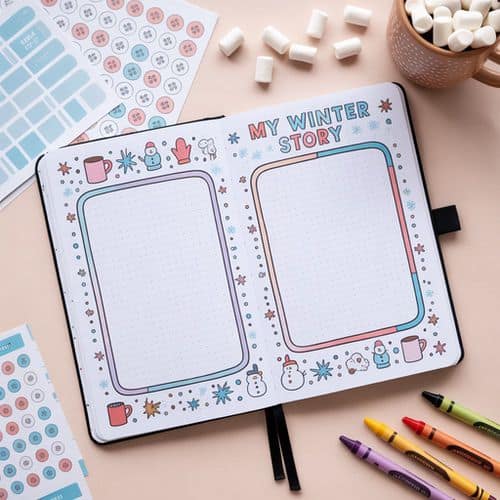
- Use stickers or cut-outs to build a winter scene and make up a story to go with it
- Design a gratitude snow globe — fill it with things they’re glad for this season
Whether you’re journaling with them or setting them up with their own notebook, this is a great way to help them express themselves, try something creative, and have fun along the way.
Set Some Seasonal Goals (Without the January Pressure)
If the whole “New Year, new you” thing makes you cringe, me too. But that doesn’t mean you can’t set a few seasonal goals that actually feel useful, and journaling is a great way to do it.
This is one of those winter journal ideas that’s more about direction than pressure. Think of it like taking stock of what matters right now, without needing a big plan or a perfect system.
Try pages like:
- A list of things you’re working towards
- A page titled Stuff I Care About Right Now
- A flexible goal spread with room for changes, detours, and pauses
You’re not trying to tick boxes. You’re just giving yourself a bit of focus for the season ahead — something you can check in with when you feel like it.
Create a Spread That Makes You Want to Open Your Journal
Sometimes the hardest part of journaling is just opening the cover. That’s where a good spread comes in – one that actually feels fun to fill out, not something you feel like you should do.
These kinds of winter journal ideas are more visual, more interactive, and a little more tempting when your motivation’s in hibernation mode. You don’t need fancy supplies — just a layout that makes you want to come back to it.
Try these ideas:
- A weekly log with boxes for wins, worries, and what’s next
- A seasonal tracker — mood, sleep, light levels, weather, anything that shifts
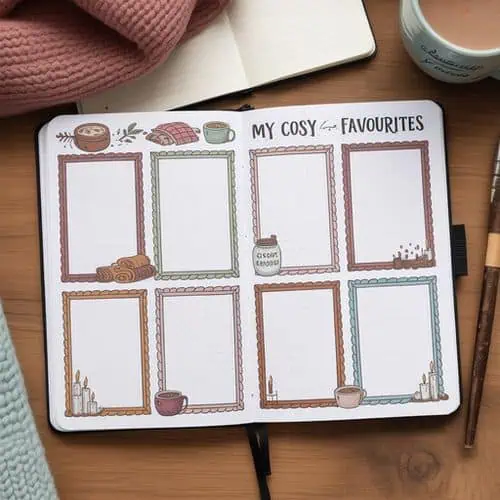
- A “cosy list” full of books to read, things to bake, films to rewatch
A nice layout can be a reason to open your journal — especially in winter, when you’re craving something that feels a bit more inviting.
Explore Seasonal Topics That Actually Mean Something
Some winter journal ideas are less about daily entries and more about following threads. By this I mean the thoughts or themes that keep popping up when things quieten down.
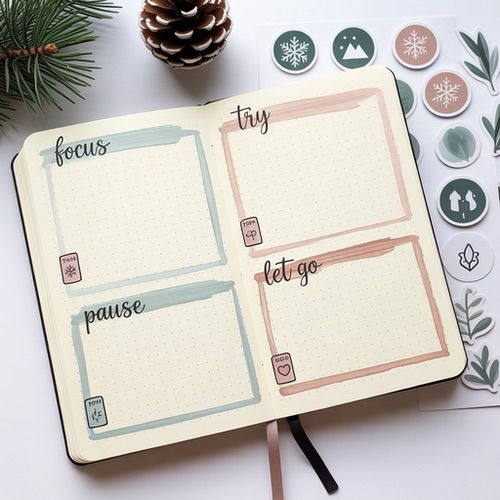
Winter’s a good time to dig into that. You’ve got more time indoors, fewer distractions, and a bit of mental breathing space. It’s a chance to notice what’s shifting underneath everything else — your focus, your energy, the things you’re carrying into the season (and the ones you’d rather leave behind).
Ideas worth exploring:
- Rest and recovery — what helps, what doesn’t
- Burnout — how it shows up and how you respond
- Seasonal shifts in focus, motivation, or emotional energy
These kinds of winter journal ideas help you make sense of what’s already there, not by solving anything, but by noticing it.
Use Winter Art Journaling to Express What Words Can’t
Some winter journal ideas work better when you switch off the words and let colour, shape, or scraps of paper do the talking.
Art journaling gives you a different way to get things out — especially if writing feels flat or repetitive. It doesn’t have to be deep or meaningful. It just has to be something that feels good to make.
Try these simple ideas:
- Use layers of paper, washi tape, paint, or texture to reflect how winter feels
- Pick a colour palette that fits your mood and build a page from that
- Turn your week into a visual map — no rules, just marks, lines, patterns, or shapes
These kinds of winter journal ideas help you shake things up and explore what’s going on underneath, without having to put it into words.
Wrapping Up
Winter doesn’t need to be turned into a project. But it’s a good time to pause, pay attention, and maybe put a few thoughts on paper. That’s where these winter journal ideas come in.
You don’t need to use every suggestion in this post. Just pick the ones that feel interesting, or useful, or fun. Let them shape your journaling in a way that fits whatever this season looks like for you.
It doesn’t have to be deep. It doesn’t have to be daily. But if you try even one or two ideas from this list, you might find yourself coming back to your journal more often — not out of habit, but because you actually want to.
Disclosure: If you purchase anything from links in this post or any other, I may receive some kind of affiliate commission. However, I only ever mention products I love and would recommend regardless of commission.
Disclosure: I’m not a mental-health or medical expert, I just share what I’ve learned through my own research and experience. The ideas and prompts here are meant to help you reflect and grow, but they’re not a replacement for professional advice. You can read my full disclaimers here.